
How to Get the Most Value from Your Credit Card in the UAE
Most people pick a credit card, set up autopay, and never think about it again. That is better than carrying a balance, but it almost certainly means you are leaving money on the table.
Know Your Earn Rates, Not Just the Headline Number
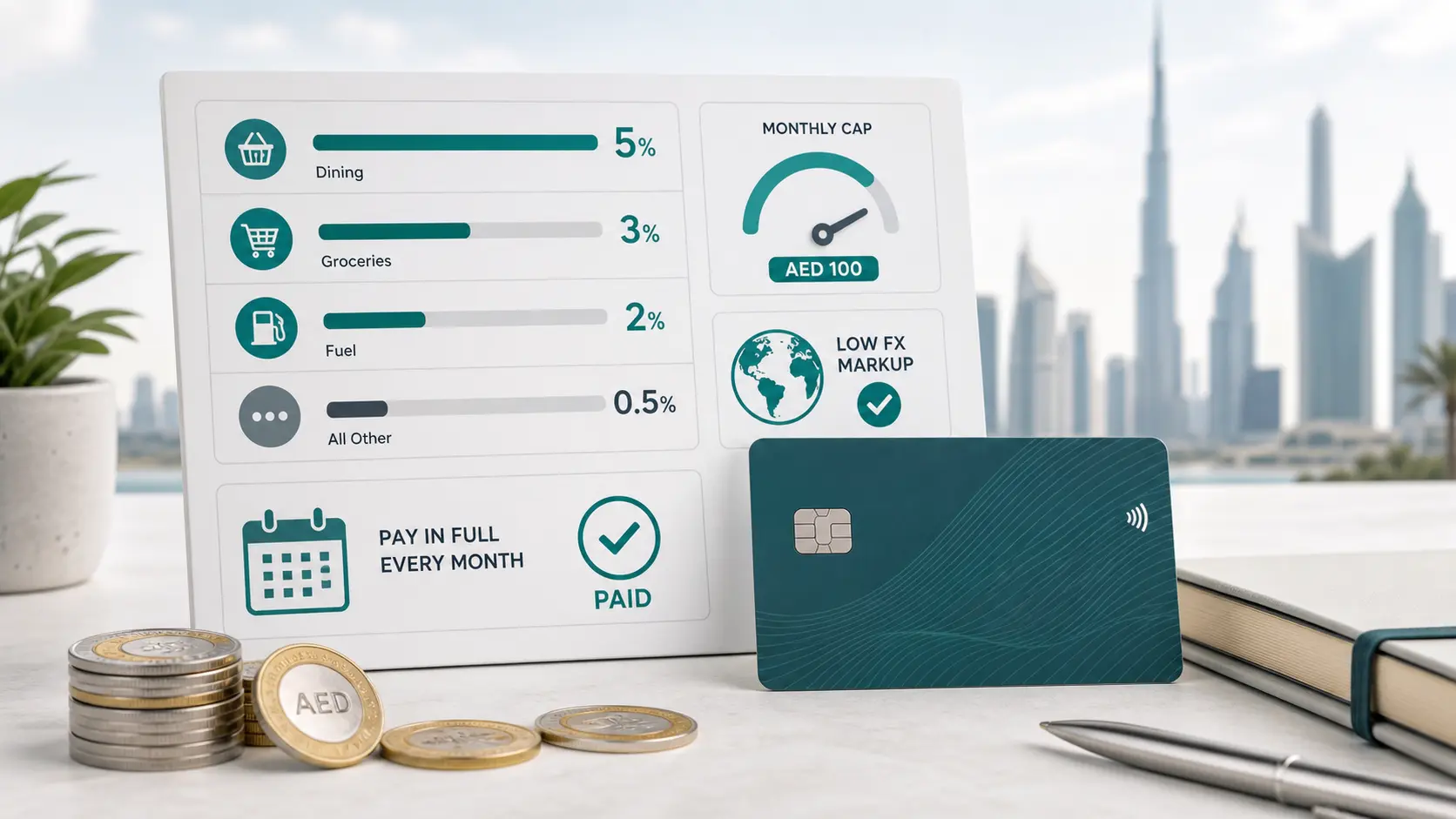
The headline cashback rate on your card is rarely what you earn on most of your spending. A card that advertises 5% cashback is typically offering that rate on a single category (dining, groceries, or fuel) while everything else earns a base rate of 0.5% to 1%. That gap matters more than most people realise.
Your highest-value category is the one that matches where you actually spend. A card offering 5% on dining is genuinely valuable if you eat out regularly. If your dining spend is modest, that headline rate is largely irrelevant to your real return. The category doing most of the work for your card may not be the one featured in the advertisement.
The “rest” or “all other” category, the catch-all for anything that does not fit a named category, almost always earns the lowest rate. Most people’s spending is more varied than they think, which means a larger proportion than expected lands in this residual bucket. Pull up your last three months of bank statements and check how much of your spending actually falls into your card’s highest earn-rate category. If that figure is below 50%, your card may be returning significantly less than you assumed.
Watch the Caps, They Change Everything
Monthly cashback caps are the most misunderstood feature of UAE credit cards, and also the most consequential. A cap is a ceiling on how much cashback you can earn in a statement period either per category or in total. Once you hit the cap, additional spending in that category earns nothing for the rest of the cycle.
The maths are straightforward once you know the numbers. A card offering 5% cashback on dining with a monthly cap of AED 100 will stop rewarding you after AED 2,000 of dining spend in a given month. Any dining beyond that point earns zero until your next statement opens. For most people that cap is never reached. But for high spenders in a particular category, it changes the actual return considerably.
Knowing your cap is not just defensive information, it is strategic. If you are regularly hitting the cap on your primary card, using a second card for that category once the cap is reached is a straightforward way to recover value from spending that would otherwise earn nothing. Check the best cashback credit cards in the UAE to compare caps alongside earn rates.
Stop Losing Money on FX Markup
Foreign exchange markup is a cost that does not appear as a line item on your statement, it is embedded in the exchange rate applied to your transaction. Most UAE banks charge between 1.5% and 3.5% on any purchase made in a currency other than AED. This applies whether you are physically travelling or simply making an online purchase billed in a foreign currency.
The scope is wider than most people account for. Amazon.com transactions billed in USD, Netflix and Spotify subscriptions, hotel bookings on international platforms, software subscriptions, and any international online retailer are all subject to your card’s FX markup. If you are making AED 2,000 per month in foreign currency purchases and your card charges 3% FX markup, that is AED 60 per month, AED 720 per year, in invisible costs.
That figure puts a different frame on cashback earnings. A card returning AED 600 per year in cashback while costing AED 720 in FX markup is a net loss. The solution is to route foreign currency spend to a card with a low or zero FX markup, which is typically a travel-focused card. Check the best travel credit cards in the UAE for options built around this use case.
Pay Your Balance in Full, Every Single Month
This is covered in detail in the beginner’s guide to credit cards in the UAE, but it is worth stating plainly here: carrying a balance eliminates any financial benefit a credit card provides. If you carry an AED 5,000 balance at a monthly interest rate of 3%, you are paying roughly AED 1,800 per year in interest. If your card earns you AED 1,000 per year in cashback, the net position is a loss of AED 800.
Minimum payments make this significantly worse. Paying the minimum, typically 5% of the outstanding balance, means the remaining 95% continues to accrue interest. The total interest paid over time on a carried balance frequently exceeds the original purchase amount. This is not a scenario where cashback or rewards offer any meaningful offset.
The practical fix is simple. Set up an autopay for the full statement balance each month. This removes the risk of forgetting, eliminates interest entirely, and means every reward or cashback you earn is genuine net value rather than a partial offset against borrowing costs.
Use the Right Card for the Right Spend
Single card approach: If your monthly card spending is below AED 3,000, one well-chosen card is almost always sufficient. The incremental value from adding a second card at this spending level is modest, and the added complexity, tracking two statements, managing two bills, potentially two annual fees, is rarely worth it. The priority at this level is choosing the right single card for your dominant spending category.
Two card approach: Above AED 5,000 per month in card spending, splitting across two cards becomes genuinely worthwhile. The most common and effective split is a category cashback card for your highest-spend categories, paired with a low-FX-markup card for everything else and for foreign currency purchases. This is how our ranking works in practice, we calculate net effective value across both scenarios so you can compare them directly.
A second card makes sense when you are regularly hitting your primary card’s monthly cap, when your primary card has a high FX markup and you have meaningful foreign spend, or when you have a substantial secondary category that your primary card handles poorly. It stops making sense when the second card carries an annual fee that your spending cannot justify, or when managing two accounts adds friction that increases the risk of a missed payment. If you are considering the two-card route, credit cards with no annual fee in the UAE are a logical starting point for the second position.
Review Your Card Once a Year
Most people choose a credit card once and keep it indefinitely. That is a reasonable default, but it assumes your spending habits and the card’s terms stay constant. Neither is guaranteed. A new job, a child starting school, a change in travel frequency, or a shift in where you shop can all meaningfully change which card returns the most value for your profile.
Card terms change independently of your habits. Banks adjust cashback rates, modify category definitions, tighten fee waiver conditions, and introduce or remove caps. A card that was optimal for your profile twelve months ago may have been restructured in ways that reduce its return without any obvious notification. The product page will still look attractive; the fine print may tell a different story.
A yearly review does not need to be extensive. Enter your current monthly spending into the card finder, compare the output against what your current card is returning, and check whether the gap justifies a switch. It takes a few minutes and, if your spending has shifted, can surface a meaningful difference.
The Short Version
You do not necessarily need a different card, you may simply need to use your current one more deliberately. Know which category earns your card’s best rate and how much of your spending actually lands there. Check the monthly cap so you know when the earn rate effectively drops to zero. Account for FX markup if you have meaningful foreign currency spend. Pay the full balance every month. And once a year, run your actual spending numbers and check whether the card you have is still the card that makes the most sense.
Both your spending and the terms of your card will change over time. The best card for your profile today is not guaranteed to be the best card two years from now, which is exactly what the card finder is built to show you.
Frequently Asked Questions
How do I know if my credit card is right for my spending?
Look at your last three months of bank statements and identify your biggest spending categories. If your card’s highest earn rate matches those categories and you are not regularly hitting the monthly cap, your card is likely a good fit. If most of your spending falls into the “all other” category at a low base rate, a different card may return more.
Should I have more than one credit card?
If your monthly card spending is under AED 3,000, one card is usually enough. Above that, splitting spend between two cards, one for your top category and one for everything else or foreign currency purchases, can increase your total return. Only add a second card if the additional value clearly outweighs any fee.
Does FX markup apply to online purchases?
Yes. Any transaction billed in a currency other than AED attracts the card’s foreign exchange markup, whether you are physically abroad or shopping on an international website from the UAE. This includes platforms like Amazon.com that bill in USD.
What is a monthly cashback cap?
A monthly cap is the maximum amount of cashback you can earn in a given statement period, either per category or in total. Once you reach the cap, additional spending in that category earns zero cashback until the next cycle. Caps vary by card and are not always prominently disclosed.
How often should I review which credit card I use?
At least once a year, or whenever your spending habits change significantly, for example, if you start travelling more, change jobs, or have a major life event that shifts your spending profile. Card terms also change, so a card that was optimal last year may no longer be the best option.