
Credit Cards in the UAE: A Beginner’s Guide to Getting It Right
Getting a credit card in the UAE is straightforward, most banks will approve you if you have a salary of AED 5,000 and the right documents. The harder part is choosing the right card and using it in a way that actually saves you money rather than costing you more.
This guide covers how credit cards work mechanically, what to look for when choosing your first card, how the application process works, and most importantly, the mistakes that quietly cost people hundreds of dirhams every year.
How Credit Cards Actually Work
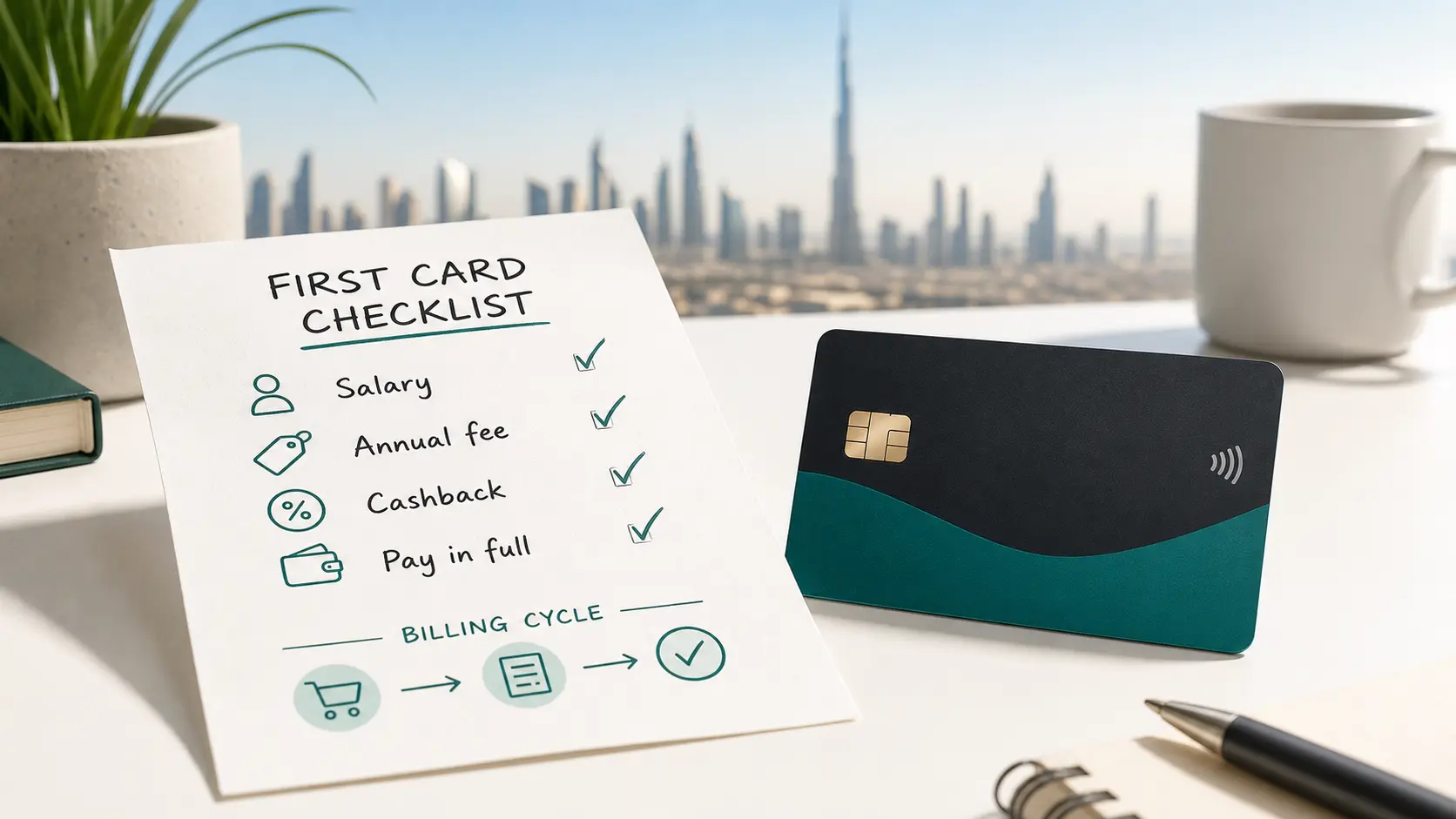
A credit card gives you a line of credit to spend now and repay later. What most people miss is the billing cycle: every month, your bank generates a statement showing everything you spent. You then have a grace period (typically 20 to 25 days) to pay the full amount. Pay in full during that window, and you pay zero interest.
If you do not pay the full balance, interest starts accruing on whatever remains. UAE credit cards typically charge upwards of 3% per month on outstanding balances, which compounds over time. A balance that feels manageable in month one can grow considerably by month six.
The minimum payment trap is where many people get caught. Banks let you pay a small fraction of your balance (often 5%) and carry the rest forward. This feels fine in the short term, but the remaining balance accumulates interest at the full monthly rate. You are not avoiding the debt; you are making it more expensive.
Your credit limit is the maximum amount you can have outstanding at any point. Banks set this based on your monthly salary, your existing financial commitments, and your credit history with the Al Etihad Credit Bureau (AECB). A higher limit is not an invitation to spend more, it is a ceiling you should rarely approach.
What to Look for in Your First Card
Most first-time applicants get distracted by welcome bonuses and flashy perks. The factors that actually matter for everyday value are simpler than that and they compound over time.
Annual Fee
For a first card, a no-fee option or a card with a fee waiver is almost always the better starting point. A fee waiver means the annual charge is dropped if you hit a minimum spend threshold during the year. Understanding how fee waivers work before you choose is worth the effort, see our guide to credit cards with no annual fee in the UAE for a full breakdown.
Cashback Rate and Categories
Cashback is a percentage of your spend that the bank returns to you, usually as a statement credit. The headline rate matters less than the category rate. If you spend most of your money on groceries and a card earns 5% on groceries but only 1% on everything else, that card is worth more to you than one earning a flat 2% across the board. Identify your biggest spending category, dining, groceries, or online shopping, and find a card that rewards it. For strong all-round options, see the best lifestyle credit cards in the UAE.
Monthly Caps
Many cashback cards in the UAE cap how much you can earn in a given month or category. Once you hit that cap, additional spending in that category earns nothing until the next statement period. Before choosing a card, check whether the cap aligns with your actual monthly spend, a generous cashback rate is irrelevant if you hit the ceiling in week one.
FX Markup
When you pay in a foreign currency, whether abroad or on international websites, most UAE cards add a foreign exchange markup of 1.5% to 3% on top of the transaction. For a first card, this is not the primary factor to optimise for. But if you shop frequently on Amazon or other international platforms, a lower FX markup can quietly save a meaningful amount over the year.
Minimum Salary
Every card has a minimum monthly salary requirement. Apply for a card you do not meet the threshold for and the bank will reject the application, and that rejection gets recorded on your AECB credit report. Multiple rejections in a short period can make subsequent applications harder to approve. Check eligibility before you apply. If your salary is around AED 5,000, see which credit cards are available on an AED 5,000 salary.
How to Apply for a Credit Card in the UAE
The application process is standard across most UAE banks. Getting the documents right before you start will save you time and reduce the chance of delays.
- Choose your card. Use the spending data you already have, your monthly outgoings by category, to find the right match. If you are not sure where to start, find the right card for your spending using our card finder.
- Prepare your documents. You will typically need a passport copy with the visa page, your Emirates ID, a recent salary certificate or three months of bank statements, and sometimes a salary transfer letter confirming your salary is paid into a UAE bank account.
- Submit your application. Most banks accept online applications. Some still require a branch visit for verification, particularly for premium cards.
- Wait for the decision. Standard processing takes 3 to 7 working days when all documents are in order. Incomplete applications or thin credit files can extend this.
- Receive your card. Approved cards are typically delivered by post within a few days of the decision, or available for collection at a branch if you prefer.
Good to know: Banks check your Al Etihad Credit Bureau (AECB) report during the application. If you have no credit history in the UAE, your first application may take longer to process. This is normal and does not mean you will be rejected.
Not sure which card to apply for? Enter your salary and spending → Try our Card Finder
The Mistakes That Cost Beginners the Most
Credit cards are genuinely useful financial tools when used correctly. Most people who run into trouble make one of five predictable mistakes.
Paying only the minimum. The minimum payment is typically around 5% of your outstanding balance. The remaining 95% carries forward and attracts monthly interest at rates that commonly exceed 3%. On a balance of AED 5,000, that is over AED 1,800 in interest over the course of a year, enough to erase an entire year’s cashback earnings and then some.
Choosing a card based on the welcome bonus. A generous first-year offer can make a card look extremely attractive. But once the bonus period ends, what you are left with is the card’s ongoing cashback rate minus its annual fee. Run the numbers on year two, not year one, before you commit. See how the best cashback credit cards in the UAE compare on an ongoing basis.
Applying for multiple cards at once. Each credit card application generates an enquiry on your AECB report. Three or four applications within a few weeks signals financial stress to banks, and subsequent applications become harder to approve. Choose one card, apply for it, and wait to see the outcome before considering another.
Using most of your credit limit. Using more than 30% of your credit limit consistently has a negative effect on your credit score. If your limit is AED 10,000, carrying more than AED 3,000 as a balance, even if you pay it off monthly, can affect how banks assess future applications.
Not reading the card terms. Fee waiver conditions, excluded cashback categories, and FX markup rates are all disclosed in the card’s terms and conditions. Most people do not read them and then are surprised when a large spend does not earn any cashback, or the annual fee is charged despite believing it was waived.
Watch out: The single most expensive mistake is carrying a balance. A credit card that earns you AED 1,000 in cashback but charges you AED 1,800 in interest is not saving you money, it is costing you AED 800.
Read more about how annual fees and fee waivers work → Credit Cards with No Annual Fee in the UAE
How to Build Your Credit Score from Day One
If you have recently moved to the UAE, you are starting with no AECB credit history. That is not a problem, but it does mean your first card is doing double duty: earning rewards and building the credit file that will determine your options in the future.
Pay your full statement balance on time, every month, without exception. Payment history is the single biggest factor in your AECB score, and a single missed payment can take months to recover from.
Keep your credit utilisation below 30% of your limit. This applies even if you clear the balance in full each month, what matters is the balance on your statement date relative to your limit.
Keep your card account open. Older accounts with good payment history contribute positively to your score. Closing your first card to open a different one resets that history. Once you have a card that works, keep it active rather than closing it when you upgrade.
Check your AECB report at least once a year at aecb.gov.ae. Errors on your report do happen, and you want to catch them before they affect a future application. For more on how card rankings and scoring work, see how our ranking works.
Your First Card – Where to Start
If your salary is around AED 5,000, start with a no-fee cashback card. There is no downside to a card that costs you nothing to hold and returns a percentage of what you spend anyway. Avoid cards with high annual fees until you have a clearer picture of which card genuinely suits your spending habits.
Before you choose, look at three months of your bank statements and identify your biggest spending category. Dining, groceries, and online shopping tend to be where UAE residents spend the most, and the cashback differential between cards in those categories can add up to several hundred dirhams a year. The best card for someone who eats out frequently is not the same as the best card for someone who does most of their shopping online.
The numbers will make the decision for you. Enter your monthly salary and spending breakdown and let the tool do the comparison.
Ready to find your first card? Enter your numbers → Try our Card Finder
Frequently Asked Questions
What is the minimum salary to get a credit card in the UAE?
Most banks require a minimum monthly salary of AED 5,000. Some offer entry-level cards starting at AED 3,000, but options at that level are limited. Premium cards typically require AED 15,000 or more.
Can I get a credit card in the UAE without a credit history?
Yes. If you are new to the UAE and have no AECB record, banks will rely on your salary, employment stability, and documentation. Your first card may come with a lower credit limit, which can be increased over time as you build a payment history.
How long does it take to get approved for a credit card?
Most banks process applications within 3 to 7 working days if all documents are submitted correctly. If additional verification is needed or your credit history is thin, it may take up to two weeks.
Should my first credit card be a cashback card or a rewards card?
For most beginners, a cashback card is simpler and more predictable. You earn a percentage back in cash, and the value is clear. Points-based cards can offer more value at higher spending levels, but the redemption process adds complexity that is not ideal for a first card.
What happens if I miss a credit card payment?
You will be charged a late payment fee, typically AED 100 to 300. If you carry the unpaid balance, interest accrues on it at rates that can exceed 3% per month. Repeated missed payments will also lower your AECB credit score, making future applications harder.
How many credit cards should a beginner have?
One. Start with a single card, learn how to manage it, and build your credit history. Adding a second card can make sense later if it serves a different spending category, but only after you are comfortable managing the first.