
How to Apply for a Credit Card in the UAE: Step by Step
Applying for a credit card in the UAE takes about ten minutes online. Getting approved, though, depends on whether you have the right documents, meet the salary threshold, and pass the bank’s credit check. Here is exactly what you need and what to expect at each stage.
Before You Apply – Check Your Eligibility
Minimum salary matters more than you might expect. Most banks in the UAE require a minimum monthly salary of AED 5,000 for standard credit cards. Premium and rewards cards typically require AED 15,000 to AED 25,000. Before applying, check the minimum salary requirement for that specific card, not just the bank’s general threshold. If you are on AED 5,000, see which credit cards are available on an AED 5,000 salary before submitting an application.
Your employment status also affects how banks assess you. Salaried employees follow the standard process covered below. Self-employed applicants and freelancers face stricter requirements and a different document set, both are covered in the next section.
Finally, check your Debt Burden Ratio before applying. UAE regulations require that your total monthly debt payments (credit cards, car loans, personal loan) do not exceed 50% of your gross monthly salary. If you are already close to that limit, a new card application is likely to be rejected regardless of your salary level.
Good to know: You can check your current DBR by listing all monthly debt payments and dividing the total by your gross monthly salary. If the result is above 50%, most banks will not approve a new credit card until your existing debt is reduced.
Documents You Will Need
The document requirements differ depending on how you are employed. Having everything ready before you start the application avoids delays and reduces the chance of rejection on a technicality.
For Salaried Employees
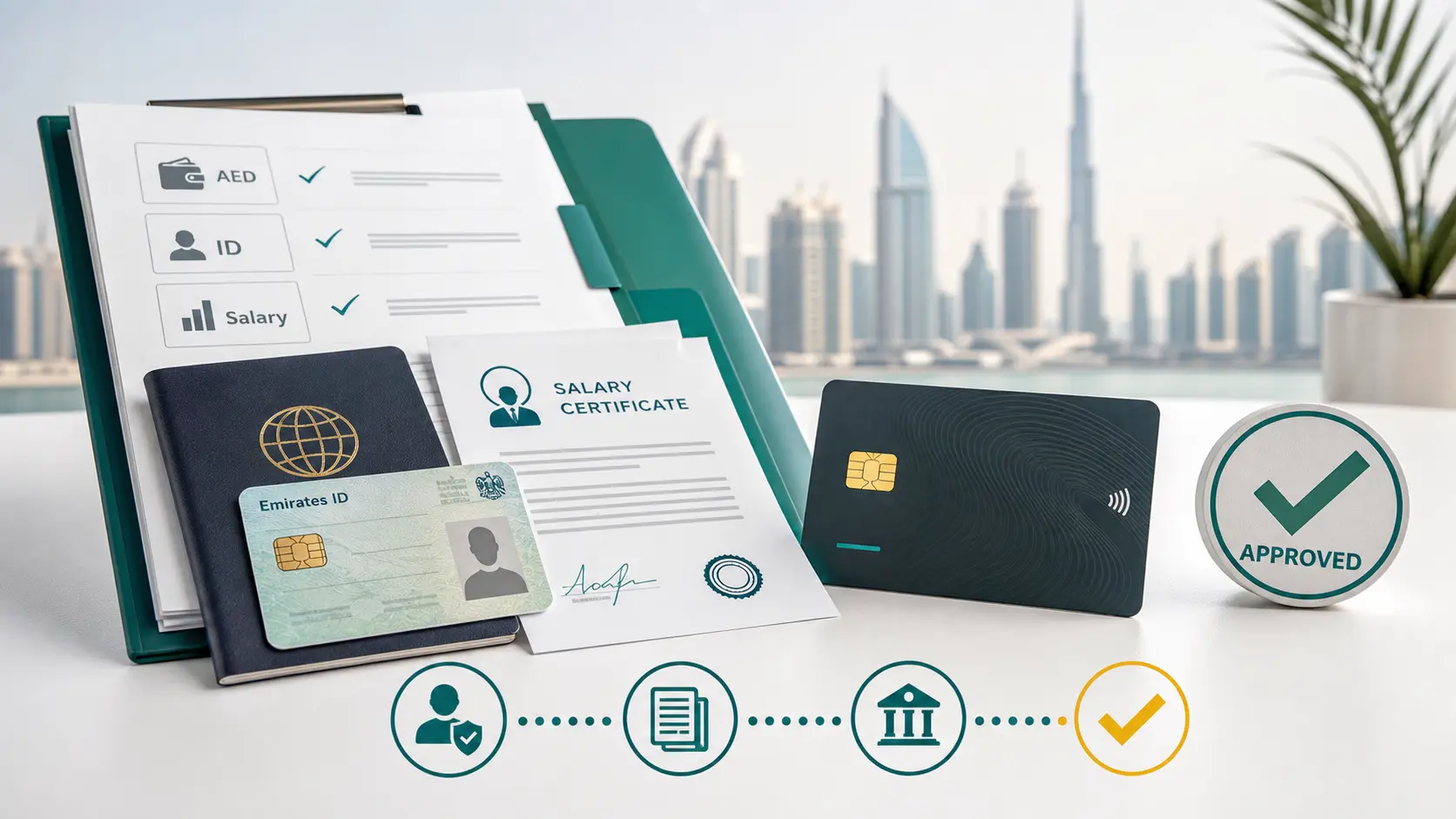
The standard document set for employed applicants is:
- Valid passport with UAE residence visa page
- Emirates ID (front and back)
- Salary certificate from your employer, dated within the last 30 days, or your last three months’ bank statements showing regular salary credits
- Salary transfer letter, if required by the issuing bank
Some banks accept either a salary certificate or bank statements; others require a salary certificate specifically. If you submit bank statements, make sure the salary credits are consistent and clearly identifiable, irregular or varying amounts can raise questions during review.
For Self-Employed Applicants and Freelancers
The requirements are stricter, and the bar is higher:
- Valid trade licence
- Last six to 12 months’ bank statements
- Audited financial statements (required by some banks)
- Higher minimum income threshold, typically AED 15,000 to AED 25,000 per month
- Some banks require the business to have been operational for at least one to two years
For freelancers holding a freelancer visa rather than a trade licence: some banks accept this, others do not. Check with the bank directly before applying to avoid an unnecessary enquiry on your AECB report. If you are weighing your options, credit cards with no annual fee in the UAE are often easier to qualify for as a first card.
Salary Transfer – Do You Need It?
Salary transfer means arranging for your monthly salary to be deposited directly into an account held with the card-issuing bank. You do this by obtaining a salary transfer letter from your employer and submitting it to the bank.
Not every bank requires it. Several banks accept credit card applications supported only by bank statements, without asking you to redirect your salary. However, applicants with salary transfer in place generally receive a higher credit limit, may qualify for cards with a lower minimum salary threshold, and tend to move through the approval process faster.
If you want to keep your salary with your current bank, you still have options, but your choice of card narrows. Some banks will ask for a higher minimum income from non-salary-transfer applicants, for instance AED 8,000 instead of AED 5,000. To see which cards offer the best value based on your actual spending, the best cashback credit cards in the UAE page filters by salary and lifestyle automatically.
The Application Process – What Actually Happens
Here is what the process looks like from start to finish, including the steps that applicants are often surprised by.
- Choose your card. Select a card that fits your spending profile and salary level. Avoid applying for multiple cards at once. Every application is recorded on your AECB report regardless of the outcome. If you are unsure which card to target, find the right card for your spending by entering your salary and monthly spend.
- Apply online or in branch. Most banks accept online applications. For premium cards, a branch visit may be required. Online applications involve uploading scanned documents; branch applications require physical copies or originals.
- Bank reviews your application. The bank pulls your AECB credit report, verifies your salary and documents, and calculates your DBR. This typically takes three to seven working days. First-time applicants with no existing AECB record may take slightly longer, as the bank relies more heavily on employment and income verification.
- Credit limit assignment. If approved, the bank assigns a credit limit, usually between one and three times your monthly salary. This limit can increase over time based on your payment history.
- Card delivery. Your card arrives within three to five working days, either by post to your registered address or for collection at a branch. Some banks use courier delivery.
- Activation. Activate the card before use, typically by setting a PIN at an ATM or through the bank’s mobile app.
Not sure which card to apply for? Enter your salary and spending → Try our Card Finder
What Banks Check – The AECB Credit Report
The Al Etihad Credit Bureau (AECB) is the UAE’s centralised credit bureau. Every bank pulls your AECB report as part of any credit card application. The report contains your existing credit facilities, payment history, total credit limit exposure, and a record of recent credit enquiries.
Your AECB score runs from 300 to 900. A score above 700 is generally considered good. A lower score does not automatically result in rejection, but it may lead to a reduced credit limit or a request for additional documentation. Banks also weigh the number of enquiries on your report, several applications in a short window signals financial pressure, even if no credit was extended.
If this is your first credit product in the UAE, you may have no AECB record at all. This is different from a poor credit history. Banks treat a clean slate differently, they focus more on income stability, employer reputation, and employment duration. For a broader introduction to how credit works in the UAE, the beginner’s guide to credit cards in the UAE covers the fundamentals. You can also check your own AECB report at any time via the AECB website, it is worth doing at least once a year, as errors do occur.
What to Do If Your Application Is Rejected
Rejection is more common than most applicants expect, and it does not always reflect a fundamental problem. The most common reasons are: DBR exceeding 50%, not meeting the specific card’s minimum salary threshold, a negative AECB record such as late payments or defaults, too many recent credit applications, or missing and inconsistent documentation. Understanding how to maximise your card’s value becomes relevant once you are approved, but first, getting there.
If you are rejected, do not immediately apply to another bank. Each new application adds another enquiry to your AECB report and worsens your profile for the next lender. Ask the bank for the reason, some will tell you, some will not. Check your AECB report for debts or errors you may not be aware of. Then wait at least three to six months, focus on reducing existing debt, and when you do apply again, target a card with a lower minimum salary requirement or a simpler eligibility profile.
Watch out: Each credit card application creates an enquiry on your AECB report, whether it is approved or not. Multiple applications within a short period signal financial stress to banks and make each subsequent application harder to approve. Apply for one card at a time and wait for the outcome before considering another.
New to credit cards? Read our beginner’s guide to credit cards in the UAE
Tips to Improve Your Approval Chances
Confirm you meet the salary and DBR requirements before submitting anything, an application that fails on eligibility wastes an AECB enquiry.
Prepare your documents in advance. Missing or outdated documents are one of the most common reasons for delays, and delays sometimes result in applications expiring and having to restart.
If you can arrange salary transfer with the issuing bank, do so. It is not always required, but it consistently improves approval odds and credit limit outcomes.
For your first UAE credit card, consider an entry-level or no-annual-fee card rather than a premium product. Entry-level cards have lower salary thresholds, simpler eligibility criteria, and a stronger approval rate for applicants without an AECB history.
Use a card comparison tool before deciding. Entering your salary and spending into a card finder shows only the cards you are likely to qualify for, rather than the full market.
Putting It Together
The process itself is straightforward. What determines success is preparation: knowing your eligibility before you apply, having the right documents ready, and choosing the right card the first time. One well-targeted application outperforms three guesses every time.
See which cards you are eligible for → Try our Card Finder
Frequently Asked Questions
How long does it take to get a credit card approved in the UAE?
Most banks process applications within three to seven working days when all documents are submitted correctly. If you have no existing AECB credit history or if additional verification is needed, the process can take up to two weeks.
Can I apply for a credit card in the UAE without salary transfer?
Yes. Several banks accept credit card applications with bank statements as proof of income, without requiring salary transfer. However, salary transfer applicants often receive higher credit limits and may qualify for cards with lower minimum salary requirements.
What is the minimum salary for a credit card in the UAE?
Most banks require a minimum monthly salary of AED 5,000 for standard credit cards. Premium and rewards cards typically require AED 10,000 to AED 25,000. A small number of banks offer entry-level cards from AED 3,000.
Does a rejected credit card application affect my credit score?
The rejection itself does not lower your score, but the enquiry generated by the application is recorded on your AECB report. Multiple enquiries in a short period can signal financial stress to other lenders, making subsequent applications harder to approve.
Can freelancers get a credit card in the UAE?
Yes, but the requirements are stricter. Banks typically require a valid trade licence, six to 12 months of bank statements, and a higher minimum monthly income, often AED 15,000 or more. Some banks do not accept freelancer visas, so check eligibility with the bank before applying.